
Shinrin Yoku
Good Afternoon. Would you not agree with me that there is nothing better than seeing golden sun rays breaking through a canopy of the most lush, vibrant and green leaves you have ever seen? What can soften a heart like a leaf quivering in fresh spring winds? What can inspire awe more than seeing the sky reflected in the spherical perfection of a single drop of dew on the powder pink petal of a fragrant flower?
Nature has an inherent magic to it, that is something none of us can deny. And you know what, even if we wanted to deny it, we couldn’t! There is actually a growing body of scientific literature that tells us that just spending some mindful time in nature actually heals us, whether we like it or not. This body of research emerged from the early 2000’s in none other than beautiful Japan, after their government started an initiative in the early 80’s to encourage their population to visit natural spaces to improve health and wellbeing, following the rapid increase of rural populations migrating into cramped, urban spaces.
This practice was named Shinrin Yoku, or Forest Bathing in English (Li, 2000). This initiative was boosted to combat ‘technostress’, which is the cumulative stress that we all build up over the many minutes, hours and days spent tethered to our technological devices, which play off of our cortisol and dopamine levels to keep us addicted, always coming back for more. I won’t waste too much time talking about stress, even though the literature has easily established the connection between our dependence to technology and our poor mental and physical health outcomes.
Today, I am focusing solely on the research supporting the beautiful practice of Shinrin Yoku. Ah, even just saying it slowly out loud is a mindful exercise. Shin-Rin-Yo-Ku. Feel the words flow from the back of the mouth, to the tip of the tongue. Feel the shape of your mouth change as you mouth out each word. Hear the sounds each word makes as it leaves your lips. Feel the vibration in your throat and chest as you generate enough energy to say the words. This kind of deep, mindful attunement sits at the heart of Shinrin Yoku. It is not putting your head down, earphones in and speed-climbing a mountain, to take a quick pic at the peak, post it on social media and jet down for an Iced Matcha and sauna at the bottom. No, no, my good friends. That is the antithesis of Shinrin Yoku.
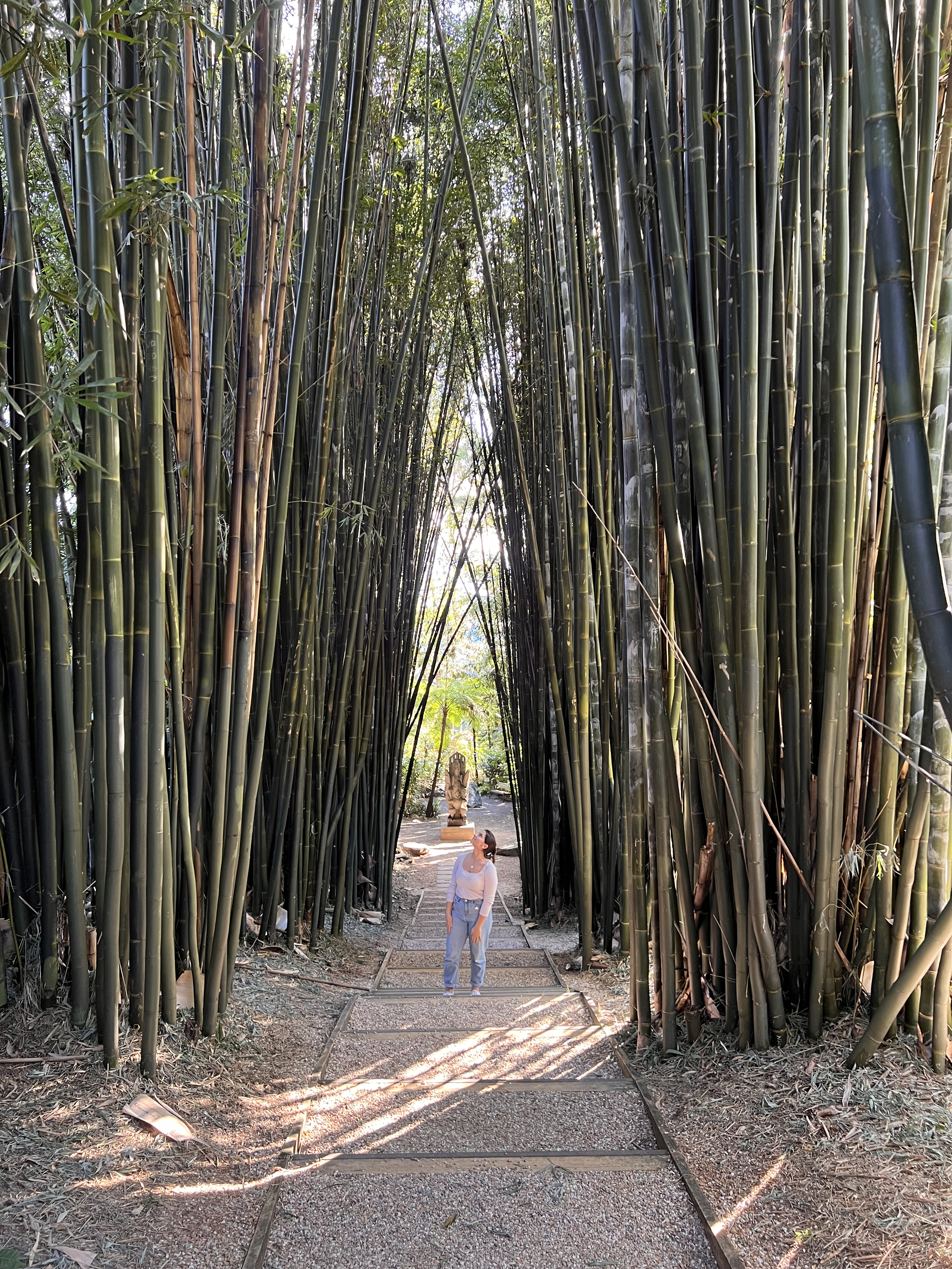
Immersed in a bamboo cluster.
Just exposing your body to a natural space and doing nothing else significantly reduces your cortisol levels, and the effects sustain over time (Antonelli, Barbieri, & Donelli, 2019).
First thing’s first, no phones. No way to be reached or accessible to anyone or anything external to yourself, if you can find a spot with no telecommunication reception, even better.
That little SOS in the top right-hand corner of my phone are the three sweetest little letters I can see. When the brain is anticipating an alert, such as the ones we receive from our phone, it enters into a chronically alert or ‘readiness’ state, which produces a low-level form of stress, which can drain our brains over time (Ward, Duke, Gneezy, & Bos, 2017).
Second, the whole point of Shinrin Yoku is the exposure and quality of awareness, not the destination or even necessarily the breath-taking beauty of the location. You use your 5 senses to enhance your experience of the natural landscape you are in;
1) The various colours, shapes, sizes and locations of the natural objects in relation to your body
2) The smell of the natural world around you and all its various quality, depth and richness
3) The texture and feel of the natural environment, sensing the minute differences in sensory input
4) The lush sounds of all of nature, living, breathing and ever moving around you
5) The tastes of the natural plants, waters and even the air, enhancing senses you rarely consider while outside your house
It is not a rushed experience, where the more you see, the better. It is about slowing down, walking with intention, mindfully absorbing as much detail as you are able to, moment to moment.
A true practice of mindfulness. I feel calm now just describing the process.
Third comes the self reflection. Invite your mind to reflect deeply within your body, allowing all the systems of survival and activation to wind-down, switch off and become present.
This invites your mind to enter into a state called soft fascination, wherein you observe stimuli that the brain does not have to work hard to process, such as the gentle swaying of a branch in the wind, a sight that our nervous systems have evolved to observe for thousands of years.
This leaves the direct attentional processes of the brain offline, allowing our brains to rest, recover and even reflect down creative pathways that we normally cannot access while we are “on”, which is what happens when the Default Mode Network operates (Basu, Duvall, & Kaplan, 2019).
Now to the juicy health benefits, take a gander at this long list of positive mental and physical health benefits of doing Shinrin Yoku, extracted from the paper by Li, 2000 and supported by multiple other meta-analytic studies (all referenced below):
Shinrin-yoku increases human natural killer (NK) activity, the number of NK cells, and the intracellular levels of anti-cancer proteins, suggesting a preventive effect on cancers.
Reduces blood pressure and heart rate, showing preventive effect on hypertension and heart diseases.
Reduces stress hormones, such as urinary adrenaline and noradrenaline and salivary/serum cortisol contributing to stress management.
Increases the activity of parasympathetic nerves and reduces the activity of sympathetic nerves to stabilise the balance of autonomic nervous system.
Improves sleep quality.
Increases the levels of serum adiponectin and dehydroepiandrosterone sulfate (helpful for insulin resistance and inflammation).
In the Profile of Mood States (POMS) test, Shinrin-yoku reduces the scores for anxiety, depression, anger, fatigue, and confusion, and increases the score for vigour, showing preventive effects on depression.
Reductions in negative repetitive thinking regarding oneself (rumination)
Enhances self-compassion, well-being, introspection, and mindfulness.
What is even more incredible, is that these health effects can last anywhere from 7 days to a whole month after your Shinrin Yoku trip! Wow!
Therapeutic Skill of the Week
I will make this super duper easy for you guys. Go sit outside in nature. For just 20-30 minutes. Leave your phone inside, and follow the prompts above where you are mindfully attuning to the natural space that you are in.
That’s it, easy peasy.
Thank you for reading this far, if you have! I truly appreciate the time and support you show to these little budding newsletters.
All my very best, with love and hope,
Tala
Poetic Reflections
“Supple chords, plucked by wind
Ever moving, ever bending
The song of divinity, unending”
- TM
References
Antonelli, M., Barbieri, G., & Donelli, D. (2019). Effects of forest bathing (shinrin-yoku) on levels of cortisol as a stress biomarker: a systematic review and meta-analysis. International journal of biometeorology, 63(8), 1117-1134.
Basu, A., Duvall, J., & Kaplan, R. (2019). Attention restoration theory: Exploring the role of soft fascination and mental bandwidth. Environment and Behavior, 51(9-10), 1055-1081.
He, M., Hu, Y., Wen, Y., Wang, X., Wei, Y., Sheng, G., & Wang, G. (2024). The impacts of forest therapy on the physical and mental health of college students: a review. Forests, 15(4), 682.
Ideno, Y., Hayashi, K., Abe, Y., Ueda, K., Iso, H., Noda, M., ... & Suzuki, S. (2017). Blood pressure-lowering effect of Shinrin-yoku (Forest bathing): A systematic review and meta-analysis. BMC complementary and alternative medicine, 17(1), 409.
Li, Q. (2022). Effects of forest environment (Shinrin-yoku/Forest bathing) on health promotion and disease prevention—the Establishment of “Forest Medicine”—. Environmental health and preventive medicine, 27, 43-43.
Siah, C. J. R., Goh, Y. S., Lee, J., Poon, S. N., Ow Yong, J. Q. Y., & Tam, W. S. W. (2023). The effects of forest bathing on psychological well‐being: A systematic review and meta‐analysis. International journal of mental health nursing, 32(4), 1038-1054.
Stier-Jarmer, M., Throner, V., Kirschneck, M., Immich, G., Frisch, D., & Schuh, A. (2021). The psychological and physical effects of forests on human health: A systematic review of systematic reviews and meta-analyses. International journal of environmental research and public health, 18(4), 1770.
Szitás, D., Halamová, J., Ottingerová, L., & Schroevers, M. (2024). The effects of forest bathing on self-criticism, self-compassion, and self-protection: A systematic review. Journal of Environmental Psychology, 97, 102372.
Vermeesch, A. L., Ellsworth-Kopkowski, A., Prather, J. G., Passel, C., Rogers, H. H., & Hansen, M. M. (2024). Shinrin-Yoku 森林浴 (Forest Bathing): A Scoping Review of the Global Research on the Effects of Spending Time in Nature. Global Advances in Integrative Medicine and Health, 13, 27536130241231258.
Ward, A. F., Duke, K., Gneezy, A., & Bos, M. W. (2017). Brain drain: The mere presence of one’s own smartphone reduces available cognitive capacity. Journal of the association for consumer research, 2(2), 140-154.